The myth of setting a high price to negotiate: what the data says (and what it costs you)
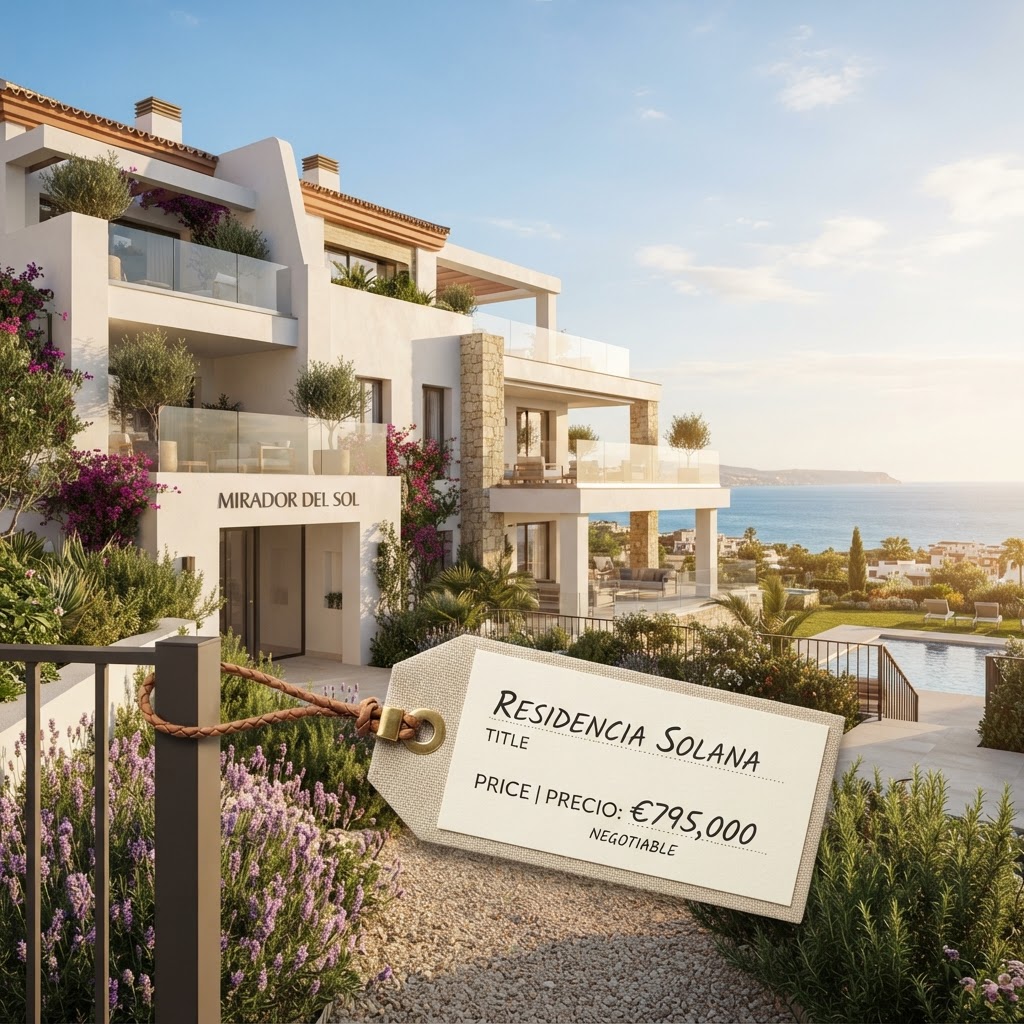
It is probably the most widespread belief in the Spanish real estate market. It is also the one that costs owners the most money. Let us break it down with numbers.
Where the "negotiation buffer" myth comes from
The logic seems flawless and comes from old-school haggling: if I ask for 100 and the buyer offers 85, we settle at 92. If I ask for 90, I will settle at 82. Therefore, asking for more is better.
The reasoning works in a market where buyer and seller are face-to-face and negotiation is guaranteed to start. A market stall. A second-hand car at a dealership.
It does not work in the real estate market, and the reason is purely technical: between your price and the buyer, there is a search filter. Negotiation only starts if the buyer actually sees your house. And if your price is outside their range, they never see it.
How a buyer actually filters
Nobody looks for a house by browsing through every listing in Málaga. A real buyer does this:
- Sets a maximum budget, almost always conditioned by what the bank grants them.
- Enters that maximum as a filter on the portal.
- Adds area, bedrooms, and perhaps a lift or garage.
- Reviews the remaining results.
If your buyer's budget is €300,000 and your house is listed at €330,000, that buyer will not see your listing. Not even once. It is not that they see it and discard it for being expensive: it is that it does not appear on their screen.
Here lies the fundamental error of the "buffer": the buyer who would have paid €305,000 for your house never knew it existed.
And there is a second, more subtle effect. The buyer with a €350,000 budget does see your listing — but they compare it with €350,000 houses. Against them, yours looks worse. You leave the market you belonged in to enter, at a disadvantage, a superior one.
The attention curve: why the first three weeks are everything
When you publish a listing, the following happens:
- Days 1 to 21. The listing is "new". It appears at the top of lists sorted by date, it triggers saved alerts for active buyers, and it is seen by everyone who has been looking in your area for months. This is the peak of exposure. It does not repeat.
- Weeks 4 to 8. The listing is no longer a novelty. It is only seen by new buyers entering the market, which is a trickle.
- From month 3 onwards. Practically only new buyers and looky-loos arrive. The accumulated pool of interested parties has already seen you and discarded you.
Lowering the price in month four does not rewind that curve. It recovers some traffic, yes, but the bulk of buyers who were actively looking at the time of your publication are no longer looking, or they have already bought something else.
The asking price is not a proposal: it is the key that opens or closes the peak of exposure.
What the data says
You do not need to take my word for it. The numbers are published.
| Data | Figure | Source |
|---|---|---|
| Listings for sale that lowered their price in a single quarter | 14 % | idealista, Q1 2026 |
| Average price cut per property in Spain | €29,390 | idealista, June 2026 |
| Average cut as a percentage of initial price | 7 % | idealista, June 2026 |
| Average cut in Málaga | 6 % | idealista, June 2026 |
| Properties taking more than a year to sell | 11 % | idealista, Q4 2025 |
| Time to sell in Málaga and the Costa del Sol with correct price | 4-8 weeks | Alfa Inmobiliaria, 2026 |
Read that together: one in seven listings ends up lowering the price, and when it does, it drops by almost 30,000 euros. That is not "well-leveraged negotiation margin". It is a forced correction, made late and from a position of weakness.
The hidden cost of overpricing
Overpricing is not free while you wait. It has three simultaneous bills.
1. Direct financial cost
Every month the property remains unsold, you keep paying. An example with conservative figures for an average flat in the Axarquía:
| Concept | Estimated monthly cost |
|---|---|
| Mortgage payment (if any) | €550 |
| Community fees | €75 |
| IBI (council tax, prorated) | €45 |
| Home insurance | €25 |
| Minimum utilities | €40 |
| Monthly total | €735 |
| Total over 10 extra months | €7,350 |
If the property is also empty, add deterioration: undetected damp, installations seizing up, garden or terrace degrading.
2. Positioning cost
The "burnt" listing. A property that has been listed for eight months with two price drops tells the buyer exactly this: nobody wanted it and the seller is giving in. It is the worst possible negotiating position, and it is self-inflicted.
3. Opportunity cost
Most of the time, people sell to buy something else. Every month you do not sell is a month you do not buy — in a market that in the Málaga province rose by 7.6% year-on-year. If your house takes ten extra months to sell, the one you want to buy has become more expensive in the meantime.
The three scenarios, in a table
Property with market valuation of €300,000 – €318,000.
| Scenario A — Starting at €305,000 | Scenario B — Starting at €318,000 | Scenario C — Starting at €365,000 | |
|---|---|---|---|
| Position | Low-mid range | High end | Off market |
| Viewings (first month) | 10-14 | 6-9 | 1-3 |
| Offers received | 2-3 | 1-2 | 0 |
| Estimated time | 4-6 weeks | 8-14 weeks | 9-14 months |
| Required drops | 0 | 0-1 | 2-3 |
| Estimated closing price | €300,000-€306,000 | €300,000-€312,000 | €290,000-€300,000 |
| Accumulated waiting cost | ~€1,100 | ~€2,200 | ~€8,100 |
| Net result | ≈ €302,000 | ≈ €304,000 | ≈ €287,000 |
Illustrative figures based on typical operations in the region. Scenario C is the "negotiation buffer".
Scenario C not only closes lower: it closes lower and with ten months of expenses on top.
What I do instead of leaving a buffer
When I value a property for sale, the process is this:
- Documented technical price bracket, with six to ten witnesses of closed transactions and explicit homogenization. The owner sees where every number comes from.
- Conscious positioning within the bracket, decided based on the timeline the owner needs rather than what they would like to charge.
- Preparation before publishing. Photography, tidying, documentation ready. The peak of exposure is only taken advantage of if the house is presentable on day one.
- Real negotiation margin, between 2% and 4%, not 15%. Enough for the buyer to feel they have negotiated, insufficient to kick them out of the search filter.
- Review at three weeks. If there are not enough viewings in three weeks, the problem is either the price or the photos. It is corrected then, not in month six.
The goal is not to sell fast just for the sake of it. It is to sell at the maximum price the market will pay, which almost never coincides with the maximum the owner imagines.
Frequently Asked Questions
How much negotiation margin is reasonable to leave?
Between 2% and 4% above the target price. It is the range that allows the buyer to close feeling they have negotiated without pushing you out of their search filter. On a €300,000 property, that is €6,000-€12,000, not €50,000.
Do buyers always negotiate the price?
No. When the price is clearly adjusted and there is more than one interested party, it is common to close at the published price or even above it. Aggressive negotiation appears above all when the buyer perceives that the property has been on the market for a long time.
What if my house is unique and has no comparables?
Practically no property lacks comparables. What happens is that you need to widen the radius or adjust the coefficients more. If the property is truly unique — a country house, an irreplaceable plot — the valuation requires a different methodology, not an invented price tilted upwards.
Does lowering the price convey desperation?
A drop, presented well and done early, does not. Three drops on a ten-month listing, yes. That is why the best time to adjust the price is week three, when you can still say "I have reviewed the market", and not month eight, when the history speaks for itself.
Isn't it better to try high for a couple of months and then lower it?
It is exactly what owners do who end up dropping €29,390 on average. "Trying" consumes the only peak of exposure your listing has. It is not a reversible test.
Do you want to know what bracket your house is in?
I can prepare a valuation for you with real witnesses and documented homogenization, for Málaga capital and the entire Axarquía. With no obligation to entrust me with the sale.
Fabiana Gastaudo is a judicial real estate expert and specialist in property valuation, operating in Málaga capital and the Axarquía region.
Sources: idealista, Analysis of price drops in sales listings, Q1 2026 · idealista, Report on property prices for sale — Málaga province, July 2026 · idealista, Distribution of sales timelines, Q4 2025 · Alfa Inmobiliaria, Real sales timelines by city, 2026.
Are you interested in better understanding how to set the right price? Read also: Asking price for a property: how to set it correctly in Málaga and the Axarquía · The real cost of waiting to sell · The 12 most common objections when selling a house