Renting in Málaga: Everything you need to know (guarantees, deposit, fees, and utilities)
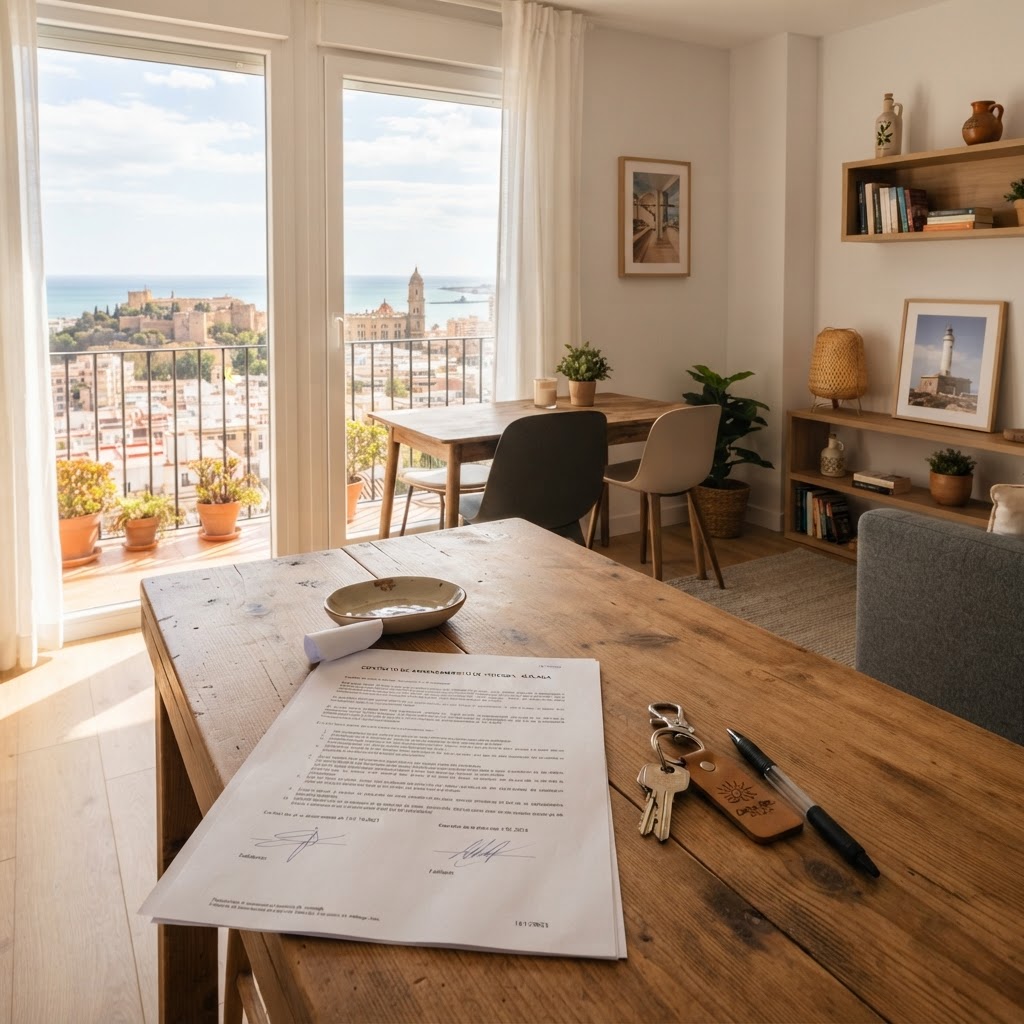
When renting in Málaga, the legal deposit is one month's rent for a primary residence and two months for seasonal or non-residential contracts. For primary residences, agency fees are paid by the landlord as mandated by Article 20.1 of the LAU; for seasonal lets, it can be agreed that the tenant pays. Additional guarantees cannot exceed two months' rent for residential properties.
Almost all conflicts between landlords and tenants arise from three things that nobody explains clearly when signing: what type of contract is actually being signed, who pays what, and what can be deducted from the deposit at the end. This article clarifies these points using the Urban Leasing Act (LAU) and the Civil Code.
The rental market in Málaga today
| Data | Figure |
|---|---|
| Rental price in Málaga city | €16.4/m² (July 2026) |
| Year-on-year variation | +2.5% |
| All-time high recorded | €16.5/m² (May 2026) |
| Range by districts | From €12.3/m² (Campanillas) to €19.5/m² (Martiricos – La Roca) |
| Is Málaga a stressed residential market zone? | No |
Source: idealista, rental housing price report, July 2026.
It is worth underlining that last point: the declaration of a stressed residential market zone is the responsibility of each autonomous community, and Andalucía has not declared any. Therefore, the initial rent caps under Article 17.6 of the LAU do not apply in Málaga. The initial rent is fixed freely between the parties (Art. 17.1 LAU).
First things first: what contract are you actually signing?
It is the decision that conditions everything else — duration, deposit, fees, renewals, and protection — and many people sign without knowing which one they are entering into.
| Primary residence lease (Title II LAU) | Seasonal / non-residential use (Title III LAU) | |
|---|---|---|
| When it applies | The tenant uses it as their permanent home (Art. 2 LAU) | Different purpose: work, studies, medical treatment, construction, summer season… (Art. 3 LAU) |
| Regulation | Mandatory in its essentials (Art. 4.2) | Freedom of contract (Art. 4.3) |
| Duration | Free, but with mandatory extensions | As agreed, no mandatory extension |
| Mandatory renewal | Up to 5 years (7 if the landlord is a legal entity), Art. 9.1 | Does not exist |
| Subsequent tacit renewal | Up to 3 more years, Art. 10.1 | Does not exist |
| Legal deposit | 1 month's rent (Art. 36.1) | 2 months' rent (Art. 36.1) |
| Maximum additional guarantee | 2 months' rent (Art. 36.5) | No legal limit |
| Agency fees | Paid by the landlord (Art. 20.1) | Freedom of contract: usually the tenant |
| Rent update | With limits set by Art. 18 | As agreed |
⚠️ Important notice for landlords. Signing a seasonal contract when the reality is a primary residence is a fraud against the law. If the tenant uses the property as their permanent home, a judge may reclassify the contract as a residential lease and apply the entirety of Title II — including the mandatory five or seven-year extensions — regardless of whether the paper says "seasonal." An eleven-month contract "because that way there is no renewal" is not a seasonal contract: it is a mislabelled residential contract.
What guarantees can a landlord legally request?
What they can demand
1. The legal deposit. One month's rent for a primary residence, two for seasonal or non-residential use. It is not optional: Article 36.1 of the LAU states that its requirement and provision are mandatory.
2. Additional guarantees. Article 36.5 allows for any additional guarantee to be agreed upon in addition to the deposit: bank guarantees, personal guarantors, supplementary deposits, or rent default insurance. However, with a limit in primary residences: they cannot exceed two months' rent for contracts of up to five years (or seven if the landlord is a legal entity). In seasonal and non-residential contracts, this limit does not exist.
3. Proof of solvency. Payslips, employment contract, tax returns, employment history, and references from previous landlords.
4. Rent default insurance. The landlord can take this out. It usually costs between 3% and 5% of the annual rent and is paid by the landlord.
What they CANNOT demand
More than one month's rent in advance. Article 17.2 of the LAU is categorical: "In no case may the landlord demand the advance payment of more than one month's rent."
Asking for "three months in advance" on a primary residence contract is against the law. Advance rent (maximum one month) is one thing; the deposit and additional guarantees are separate legal figures.
Exceeding the additional guarantee cap in residential housing. Deposit (1 month) + additional guarantee (max 2 months) = three months maximum in primary residences, in addition to the first month's rent.
Why landlords have become so demanding
The landlord who rents in Spain assumes an asymmetric risk: if the tenant stops paying, the rent is lost from the first month, but recovering the property through the courts takes months. In the meantime, they continue to pay IBI (property tax), community fees, insurance, and in many cases, the mortgage.
It is useful to separate two things that are often confused:
- Illegal occupation (okupación): someone enters a property without any title. This is a criminal matter.
- Non-payment of rent ("inquiokupación"): there is a valid contract and the tenant stops paying. This is a civil matter, resolved via eviction for non-payment, and has nothing to do with illegal occupation.
What this means in practice: for a landlord, rent default insurance and serious solvency filtering are far more valuable than an endless list of guarantees that scares away good tenants. And for the tenant, it is wise to arrive with documentation prepared.
Who pays agency fees?
For primary residences: the landlord pays
Article 20.1 of the LAU, following the reform introduced by Law 12/2023 on the right to housing:
"The costs of real estate management and contract formalisation shall be borne by the landlord."
It is mandatory. The opposite cannot be agreed upon in a primary residence lease.
For seasonal and non-residential use: it can be agreed
Article 20 does not apply to non-residential leases (Title III). In a seasonal contract, agency fees can be legally agreed to be paid by the tenant, and in practice, this is the norm.
| Contract type | Who pays the fees | Legal basis |
|---|---|---|
| Primary residence | The landlord, no possibility of agreement to the contrary | Art. 20.1 LAU |
| Seasonal (studies, work, summer) | As agreed; usually the tenant | Arts. 4.3 and 30 LAU |
| Commercial premises or other use | As agreed | Arts. 4.3 and 30 LAU |
Utilities and expenses: who pays what?
| Concept | Borne by | Legal basis |
|---|---|---|
| Utilities with individual meter (electricity, water, gas) | Always the tenant | Art. 20.3 LAU |
| Non-individualised general expenses (community, IBI, taxes) | Landlord, unless a valid written agreement exists | Art. 20.1 LAU |
| Repairs necessary to maintain habitability | Landlord, without increasing rent | Art. 21.1 LAU |
| Minor repairs due to ordinary wear and tear | Tenant | Art. 21.4 LAU |
| Damage caused by the tenant | Tenant | Arts. 1563 and 1564 CC |
| Real estate management and formalisation (primary residence) | Landlord | Art. 20.1 LAU |
The requirement that invalidates many agreements. For the tenant to take on general expenses — community, IBI — Article 20.1 requires that it is stated in writing and that the annual amount of those expenses at the date of the contract is determined. A generic clause without a figure is open to dispute.
The deposit: what it is, how much it is, and how it is returned
How much:
- Primary residence: one month's rent.
- Seasonal and non-residential: two months' rent.
Andalusian update: no longer required to deposit with AVRA
The Andalusian Housing Law 5/2025 repealed the obligation to deposit the bond with AVRA, effective from January 24, 2026. The obligation to demand and provide a deposit remains intact (it is part of the LAU, state law). The change is not retroactive.
When and how it is returned
The deposit is returned upon termination of the contract, once the state of the property has been checked and it is confirmed that there are no outstanding rents or utility bills. Article 36.4 of the LAU establishes that if one month passes since the return of the keys without a refund, the balance accrues the legal interest of the money.
The deposit is not the last month's rent. Stopping payment of the last month "because you already have the deposit" is a breach of contract, and leaves the landlord without a guarantee against potential damage.
What can be deducted from the deposit and what cannot
The dividing line: normal wear and tear from the passage of time is not deducted; damage attributable to the tenant is.
| ✅ CAN be deducted | ❌ CANNOT be deducted |
|---|---|
| Unpaid rent | Painting due to the mere passage of time and normal use |
| Outstanding utility bills in the landlord's name | Wear of the floor, countertops, or tiles from ordinary use |
| Agreed community fees not paid | Appliances that fail due to age or end of useful life |
| Breakages and damage caused by the tenant | Structural damp or building problems |
| Broken, missing, or unusable inventory items | Repairs necessary for habitability (Art. 21.1 LAU) |
| Large holes, drill marks, or wall damage | A couple of standard marks or nails after several years |
| Extraordinary cleaning if the property is left in poor condition | Standard handover cleaning |
| Changed locks without returning a copy | Blinds or faucets that fail due to age |
The criteria an expert uses to decide: would this have occurred anyway with diligent use over the same time? If the answer is yes, it is ordinary wear and tear and is assumed by the landlord. If no, it is damage attributable to the tenant.
If you are charged for a piece of furniture: does the landlord have to buy it and show you the invoice?
They are not obliged to replace the item. What is deducted is compensation for the financial damage suffered, not reimbursement for a purchase. However, they are required to prove the damage and justify the amount: that the item existed and was in good condition, that the damage is attributable to the tenant, that the amount is reasonable, and that depreciation due to age has been applied.
The inventory: the tool that avoids 90% of conflicts
Before signing and handing over the keys, both of you should make an inventory of the property:
- List of furniture and appliances, with brand, model, and approximate age.
- State of each room, with pre-existing damage noted.
- Dated photographs of everything, including defects that already exist.
- Readings of electricity, water, and gas meters.
- Number of key sets delivered.
- Signed by both parties and attached to the contract.
Without it, Article 1562 of the Civil Code applies, which presumes that the tenant received the home in good condition. Repeat the same inventory on the day of the return of the keys.
Frequently Asked Questions
How much deposit can I be asked for to rent in Málaga?
One month's rent for a primary residence and two if it is a seasonal or non-residential contract, in accordance with Article 36.1 of the LAU. In addition, additional guarantees may be agreed upon, which, in primary residences, cannot exceed two more months' rent.
Is it legal to ask for three months in advance?
No, if it refers to rent. Article 17.2 of the LAU expressly prohibits demanding the advance payment of more than one month's rent. The deposit and additional guarantees are different legal figures.
Who pays agency fees for a rental?
For a primary residence, the landlord: Article 20.1 of the LAU establishes that real estate management and contract formalisation expenses are borne by the landlord, without the possibility of agreement to the contrary. In seasonal contracts, it can be agreed that the tenant pays them.
Can the landlord keep the deposit for normal wear and tear of the flat?
No. Wear and tear derived from ordinary use and the passage of time is assumed by the landlord, in accordance with Article 1561 of the Civil Code.
When do I get my deposit back?
Upon completion of the contract, after checking the condition of the property and ensuring there are no outstanding debts. One month after the keys are returned without the refund, the balance accrues the legal interest (Art. 36.4 LAU).
Is it still mandatory to deposit the bond with the Junta de Andalucía?
No. The Andalusian Housing Law 5/2025 repealed the obligation to deposit the bond with AVRA as of January 24, 2026. The obligation to require and provide a deposit remains in force.
Is Málaga a stressed residential market zone?
No. Andalucía has not declared any stressed zones, so in Málaga, the initial rent is fixed freely between the parties.
Can I sign an eleven-month contract to avoid mandatory renewal?
Not as a shortcut. If the tenant uses the home to satisfy their permanent need for housing, the contract is a primary residence lease regardless of its nominal duration. A seasonal contract is only valid if there is a real, explicit, and documented reason for the temporary nature.
Are you about to sign a rental contract?
I review rental contracts — for primary residences, seasonal, and student lets — before you sign them, and I prepare expert reports on the state of a property and the valuation of damage when there is a disagreement over the deposit.
I work in Málaga city, Vélez-Málaga, Torre del Mar, Nerja, Torrox, Rincón de la Victoria and the rest of the Axarquía.
Notice. This article is for general information and educational purposes only and does not constitute legal advice for a specific case. Rental and housing regulations change frequently, both at state and regional levels. Before signing or making a claim, consult your case with a professional.
Regulatory sources: Law 29/1994 on Urban Leases (LAU) · Civil Code, arts. 1555, 1561-1564 · Law 12/2023 on the right to housing · Law 5/2025 on Housing in Andalucía · idealista, Rental housing price report — Málaga city, July 2026.
Would you like to keep reading? Selling in Andalucía: documentation, costs, and taxes · Cadastral reference value · Real estate expert witness in Málaga